


I’ve decided to number my thank you notes since I am endlessly grateful for the lessons I learn from our furry friends. Dogs really are some of our most humble teachers.
First off, dogs nail compassion. They listen and snuggle and they’re authentic. They stay by our sides and offer loving presence even in the darkest of times.
Dogs live in the moment and remind us to do the same. No matter the load I carry, when I watch my dog run free, ears flapping, tail wagging, loving life, I’m showered with joyful feelings. I remember to breathe and take in the good. It’s therapy.
So…THANK YOU, dogs, for being there for us. Thank you for your companionship, for getting us outside and keeping us healthy. Thank you for your unconditional love and connection. You teach us patience and responsibility and how to be present without judgment. You remind us to keep perspective and finely tune our sense of humor.
You’re life saving and we love you. Thank you.
xo
Waiting at a stoplight the other morning, I found myself face-to-face with a bumper sticker promoting kindness. I felt grateful for the reminder and I began thinking about what it really means to be kind…
Kindness lifts our spirits and inspires us. It connects us, and we believe in it so much that we go out of our way to teach young children to be kind to one another. Kindness is encouraging, it’s powerful and far-reaching. It has layers and context and manifests in so many different forms. And, although it’s difficult to define, we know how kindness feels and, ultimately, that seems important.
I believe kindness matters…a lot. And to fully honor it we’re asked to go beneath ideals and acknowledge how much awareness is required. Not just once in awhile, but ongoing throughout our lives. Being kind is a practice. And, although it may be easy to promote, we can likely agree how challenging it can be to embody sometimes. Our moods, our thoughts and beliefs, our life circumstances and experiences can get us caught up. We get self-righteous, impatient and we forget to be kind. Even with the best of intentions, sometimes we’re reactive and we think, say and do things that are hurtful.
Sometimes our hearts close and kindness becomes exclusive…It becomes something reserved for us not them. When I catch myself in this place, I’m reminded that more love is needed, not less. I start with loving myself…the one who is struggling to be kind…and I go from there.
This feels like the heart of the message I want to share with each other. The message that kindness is good and important and we should continue the practice. But it’s also hard sometimes and it takes courage. And right now, in this charged political climate, we need courage. Maybe we need to talk more about how to practice kindness when it doesn’t come easily…when we find ourselves challenged to show it. How can we keep our hearts open and go with kindness even when we disagree or feel anger or fear?
Because…let’s face it, we’re human. And it’s hard sometimes. And it’s messy. And it’s complex and emotional and raw and beautiful and we all have that in common.
And…yes…kindness matters.
xo
“Anger isn’t allowed at school.” ~ 4th Grade Student
I’ve heard students identify themselves as “angry” or “bad” before they’ve even made it through elementary school. It got me thinking about the messages they’re receiving. Over the years, it’s become clearer to me how often kids confuse anger with the consequences generated when they act out of anger and rage. They haven’t learned to separate anger from their reactions to it. The assumption is that anger is “bad” because they “got in trouble”. Early on, we can develop a negative relationship with anger.
It’s a lifelong practice to be with the difficult energy that we call anger. It’s an emotion we often don’t like because of how it feels and because of how we find ourselves acting out of it. Anger itself is not a problem. As challenging as it is, we can develop strategies to work with the energy, to settle ourselves down before responding in triggering situations. We see kids struggle with reactivity and we know adults struggle too. It’s part of the human condition. As strange as it may sound, we can get to know our anger and actually befriend it. What does it look like? What does it have to say? It’s not easy, but we can practice ways to support ourselves in making more skillful choices when we’re angry or upset.


With my 4th grade class, I recently taught a lesson highlighting parts of our brain that relate to emotions and decision-making. I’m not a neuroscientist so I made my best “ish” drawing of the brain. I labeled the prefrontal cortex, amygdala and hippocampus. We talked about the role of each and how we can see their jobs manifest in our daily lives. I love bringing this topic to light because kids start to see that everyone gets triggered sometimes and may react out of fear, anger and frustration. Our “security guard” is trying to keep us safe and sometimes we overreact. We can use strategies to settle down our stress response and give ourselves space to make more thoughtful decisions.
When our “thinking brain” can see more clearly, we’re available to make skillful choices and take responsibility for our actions. Through sharing, kids listen to each other and see they’re not alone in experiencing anger. We come together as a community as we practice strategies to support mindful responses to challenging situations.
Here are a few book recommendations that support working with emotions:
Be well!
xo

Terminal Uniqueness
A few years ago, I was on a mindfulness retreat and one of the teachers talked about staying true to what you know, trusting your heart and listening to others. She said, “We are all suffering from terminal uniqueness.” We often have a sense that we’re the only one with a particular challenge and that no one understands what we’re going through. We feel isolated, we tighten, and we close.
When we feel safe enough to expose our vulnerability and are willing to share about the parts of life that tend to live in the shadows, we find connection. We open ourselves up to see that we’re not alone in our struggles. When we’re willing to take this brave step, we expand the safe space for others to do the same. The triggers for each of us are different but we can connect through the shared human experience of knowing how it feels. This connection can be life saving.
It can also be scary. It’s possible that our social and professional cohorts don’t encourage such openness. I think it’s skillful to consider your environment and remember that people tend only to be available for you as deeply as they’re available for themselves. That being said, I believe that the more we’re all willing to be vulnerable and authentic together, the less scary it will be. I think it’s safe to say that we all want our children and young adults to feel connected, accepted and safe to share their challenges without fear or shame. We can provide this space only to the degree that we’re willing to be authentic and gentle with our own human experiences.
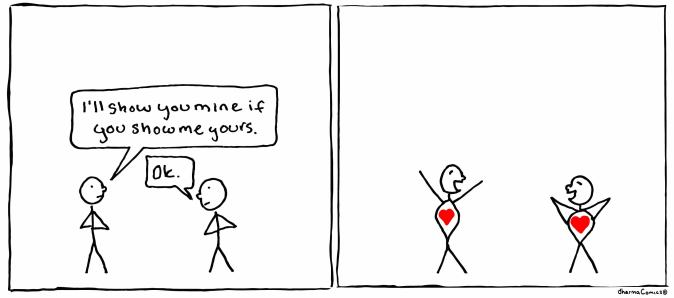
Pema Chodron reminds us…
“The raw, vulnerable place is where wisdom comes. Don’t shame yourself or put yourself in the ‘bad people’ category. Just feel what you feel. Be with the rawness. This is how humans feel. There is nothing wrong here.”
xoxo
Have you ever sat down to breathe and relax only to find you’re entirely worked up? Perhaps you already knew that which is why you chose to sit down and breathe in the first place. Other times, we don’t have the slightest idea how charged we are in body and mind until we sit down and get quiet.
When I take time to get quiet and check in with myself, it gives me insight into my mood, my thoughts and the general quality of my interactions. Sometimes just the act of sitting and breathing for awhile helps my body and mind settle. Then there are times when I need a little more support…some tools to help me follow my breath. A practice that helps me direct my attention more specifically is called Square Breath.
I did not invent the Square Breath, but it’s a tool I’d like to share with you today because you may find it as helpful as I do. When my mind is racing from one thing to another, the Square Breath helps me focus my attention on my breath in a structured way. After a few minutes of this practice, I typically find my body and mind more aligned, my breath more regulated and I feel more grounded.
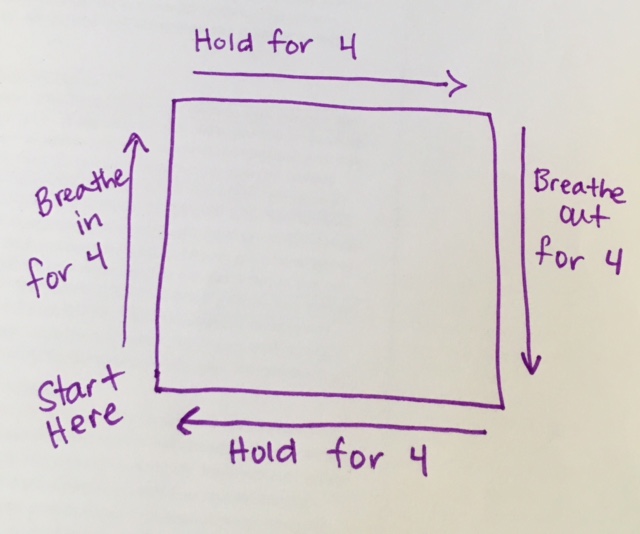
Here’s how to practice:
- Sit in an upright, yet relaxed position
- Let your eyes gently close if you like
- Begin by taking a few deep breaths then allow your breath to move in and out organically
- Visualize a square
- Breathe in for a count of 4 as you trace the left side of the square from bottom to top
- Hold your breath in for 4 as you trace across the top of the square from left to right
- Breathe out for 4 as you move down the right side of the square
- Hold your breath out for 4 as you move along the bottom of the square back to the left corner
- Repeat…
I find that in this culture of busyness, it’s helpful to have tools for settling our nervous systems. Enjoy!!
xo
“You cannot get through a single day without having an impact on the world around you. What you do makes a difference and you have to decide what kind of difference you want to make. “
– Jane Goodall
Thank you for leaders who model compassion for themselves and others, who foster connection, humility and try to stay grounded. Thank you for leaders who look at the big picture and act out of dignity and respect. Thank you for leaders who remind us that cultivating these qualities requires intention, attention, commitment and practice over and over again.
I heard Pema Chodron once say that, “Society is just a bunch of Us.” This is a useful thing to remember.
We are society. We don’t have to be famous to be mindful leaders. What we do and say each and every day matters. Thank you, all of you, for being here and for your presence.
“The best way to take care of the future is to take care of the present moment.”
-Thich Nhat Hanh
xoxo
With what seems to be an everlasting to-do list, teaching, planning and homework to be done, I’m trying my best not to let a single ball drop. Sometimes it feels like I’m striving for an A+ in life. Sound familiar to anyone?
Well, a moment of awakening came last night when my husband pulled a bag of cheese puffs out of the refrigerator and looked to me for an explanation. After a good laugh, I decided to sit down, take some deep breaths and get quiet. It was quite clear that I would benefit from reconnecting my mind with my body.
I set Insight Timer on my phone for 15 minutes, closed my eyes and sat quietly. I immediately noticed thinking, thinking and more thinking. My mind jumped from upcoming deadlines to scenes from the past to decisions I need to make to self-doubt and I sensed a charge of impatience and anxiety throughout my body. It took an incredible amount of effort to sit still for 15 minutes.
Although not always easy, sitting quietly, even for a few minutes, supports me in awareness of my general state of being. I practice accepting that right now my mind is doing a lot of thinking. That’s what the mind does. It’s no surprise to me that the busier we get in our daily lives, the more our minds race. I also know it’s not always this way.
Part of my practice is to honor that I’m doing my best, that I’m human and to embrace good enough. My wish for us all is to remember that we’re good enough and to have compassion for the parts of ourselves that are working overtime to get an A+.
And…by the way…chilled cheese puffs aren’t so bad.
xo
Brother David Steindl-Rast says, “In daily life we must see that it is not happiness that makes us grateful, but gratefulness that makes us happy.”
I recently came across a post by author Elizabeth Gilbert and she was talking about this wonderful thing called a Happiness Jar.
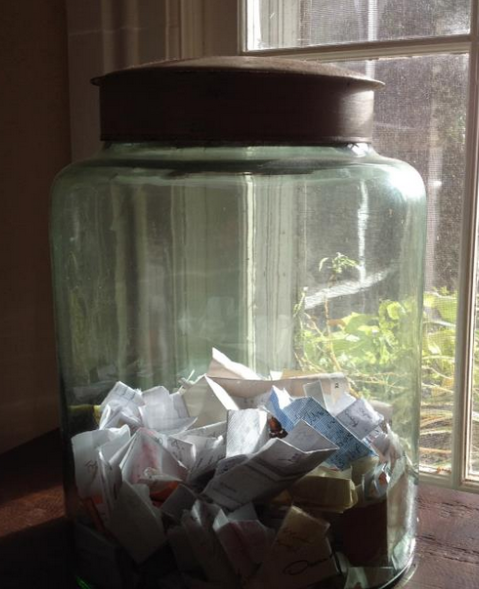 I was so intrigued, I began a simple internet search to find out more.
Here’s the basic idea: Write down one happy moment every day of the year and put it in a jar. It’s that simple. The main challenge is remembering to do it.
The practice of paying attention to small moments can ground us into what really matters. We can generate gratitude for things we may otherwise overlook. Similar to keeping a gratitude journal, this practice strengthens our attention toward positives when our minds may more frequently gravitate toward noticing what’s wrong. That being said, simply beginning to notice our habits of mind is an interesting investigation in itself.
Back to the Happiness Jar…As I thought more about it, the teacher in me began brainstorming the possibilities of a Happiness Jar in my classroom. It’s simple enough to implement and can support both teachers and students in shifting our attention toward gratitude. I also like the possibility of creating a collective “bank” of happy moments. I can see this being supportive during times of difficulty. Anyone who needs a little boost (teachers included) can go to the jar, pick up a card, read it and remember a moment of happiness. Such a great way to cultivate connection within the classroom community!
I’m so grateful for learning new ideas!!
xo
One reason I love Spring Break is that I have more time to read. I enjoy variety so I tend to vacillate between just-for-fun books (currently Amy Poehler’s YES PLEASE), books that support my personal/professional growth and home decorating magazines. I also come across a wealth of great articles online. I save the links in a folder so I can go back to them when I have time to really dig in and concentrate.
This week I read an article called, “The Importance of Naming Your Emotions,” published by The New York Times. I was hooked by the title and interested to see that the content aligned with the theme of my last blog post. The article supports the value in learning how to notice, name and take care of our emotions juxtaposed with common societal expectations to leave our feelings at the door. In my last post, I highlighted one way I practice noticing and naming emotions with my students, however, there are clearly benefits for all of us in slowing down and checking in with ourselves.
If you’re interested, check out this short video with Dan Siegel, M.D. Executive Director, Mindsight Institute that illustrates what happens in your brain when you practice naming a strong emotion. Dan refers to this practice as “Name it to Tame it.”
Enjoy!
xo
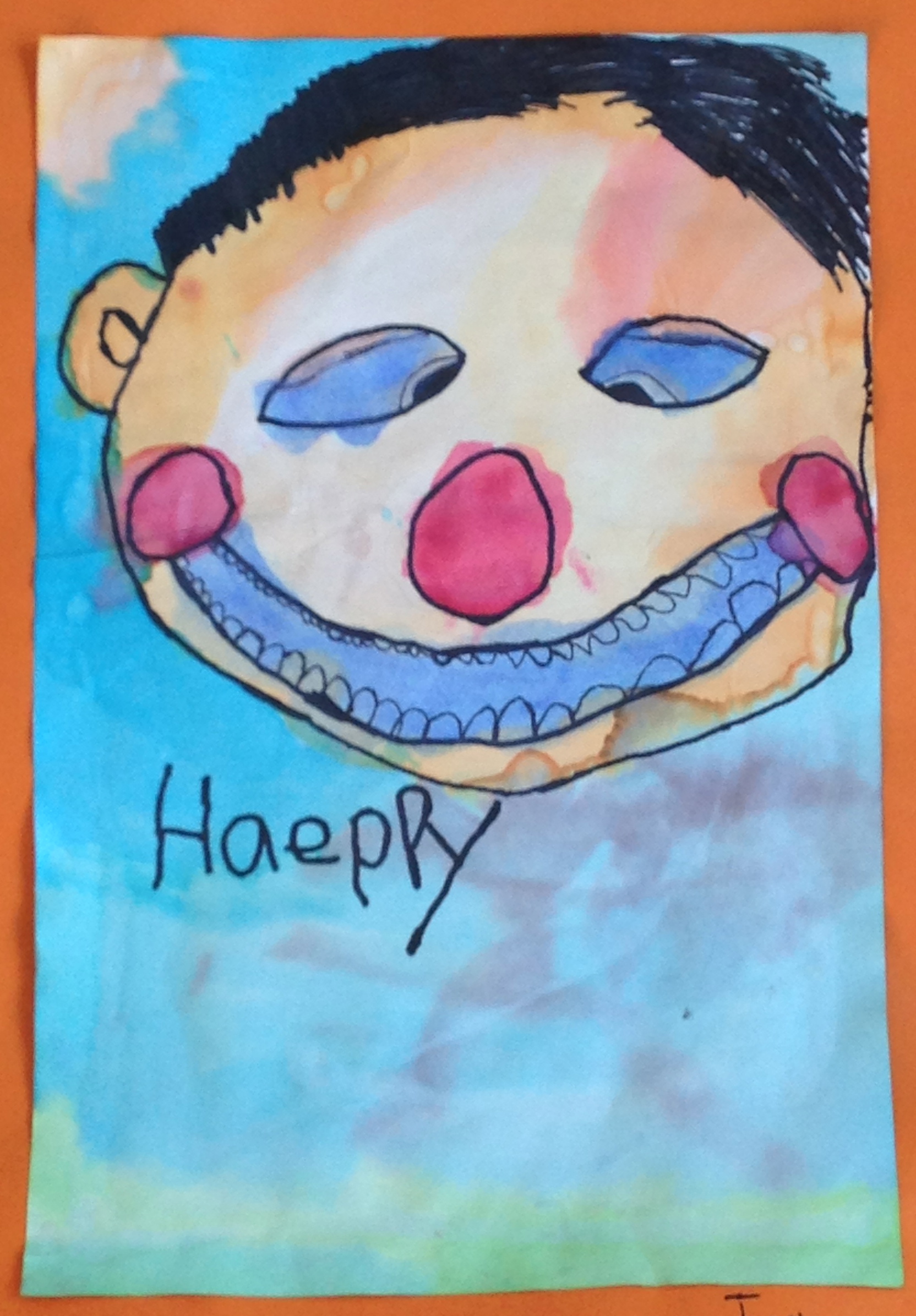
We regularly ask people how they’re doing and, on occasion, we’re genuinely available for their response. There are also many times when “How are you?” is more of a social gesture, a brief acknowledgment as we pass by, but we’re not really available to stick around for the whole story. We accept a quick “I’m fine. How are you?” before changing the topic or continuing on our way. Quite frequently, we’re so busy moving from one thing to the next that we can’t recall the last time we checked in with ourselves.
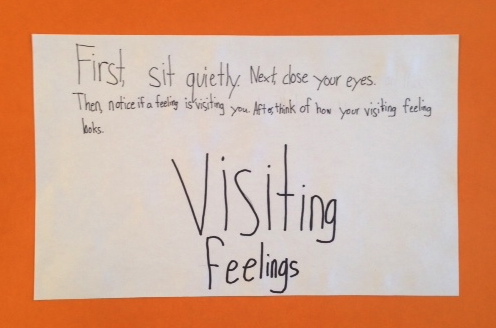
I invite you to take a few minutes to follow these simple steps written by one of my first grade students. Not only did she reflect upon what she’s practiced in our class, she went through the writing process to plan and sequence the steps she feels are most important to teach. Last week, she led our entire first grade class through the practice of sitting, breathing, noticing and naming their visiting feelings while I enjoyed being a participant.
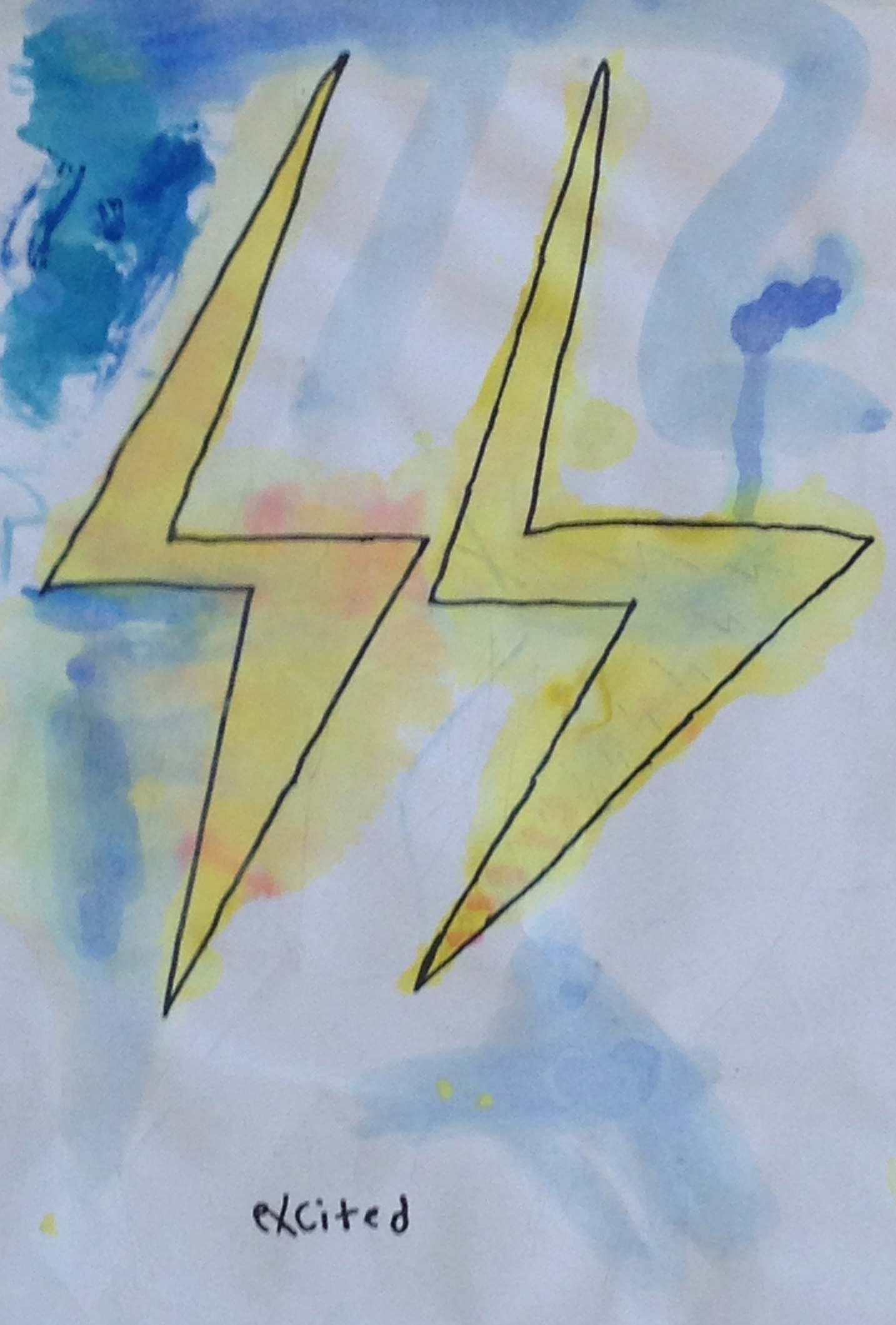
It warms my heart to see children at ages 6-7 learning how to investigate and befriend their inner world of emotions, develop a language to describe how they’re feeling, and start to recognize that feelings come and go. This practice also supports us in noticing when we’re caught up in strong emotions and acting out. It invites us to slow down, allowing our body and mind to settle, so we can more skillfully respond rather than react.
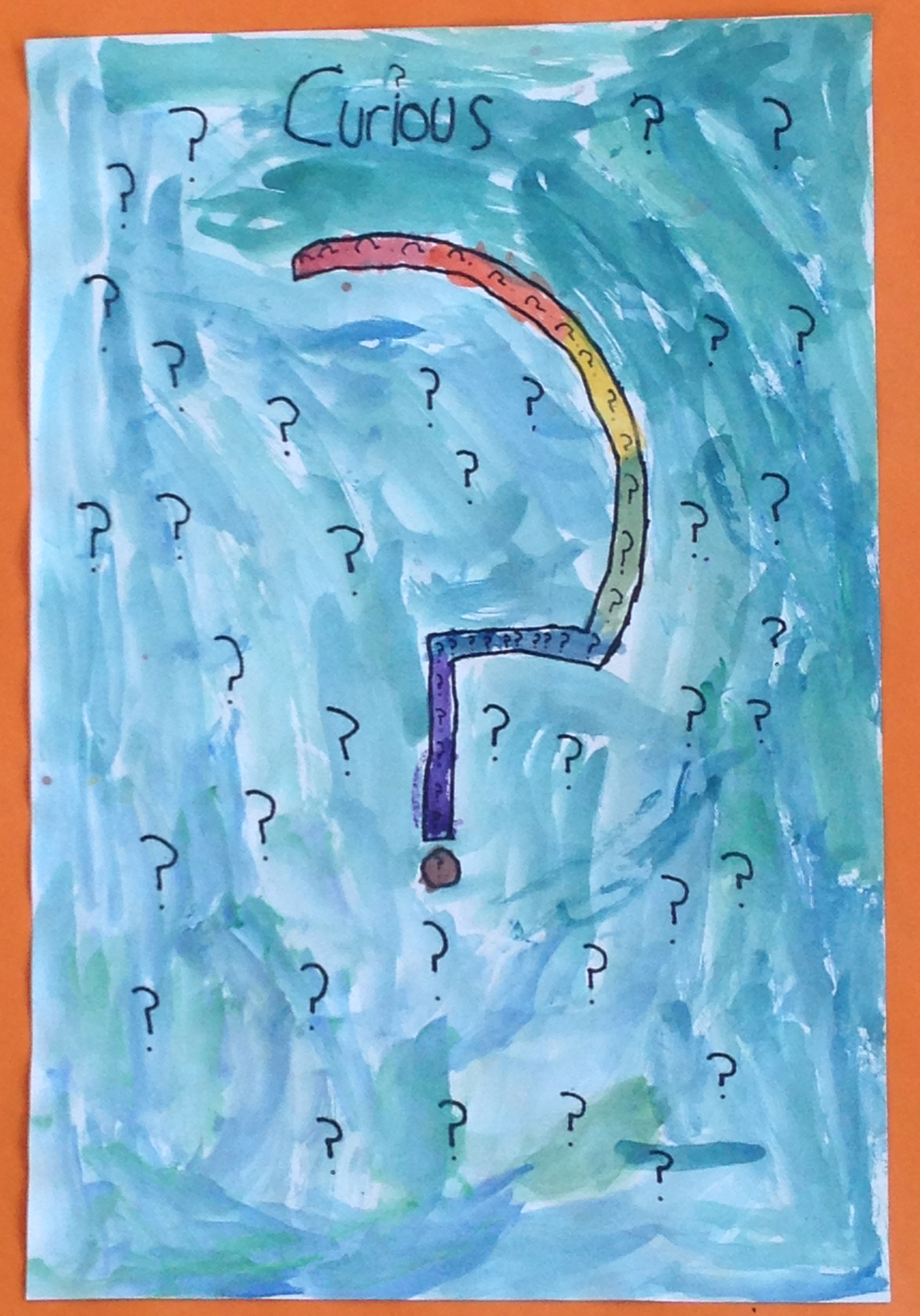
*As a follow-up to our practice, we sketched and painted our visiting emotions. We have a chart on the wall in our classroom named “Our Visiting Feelings”. When a new emotion comes to visit we add it to the list. I also recommend reading Visiting Feelings by Lauren Rubenstein. This book invites children to investigate all types of human emotions in an objective and creative way.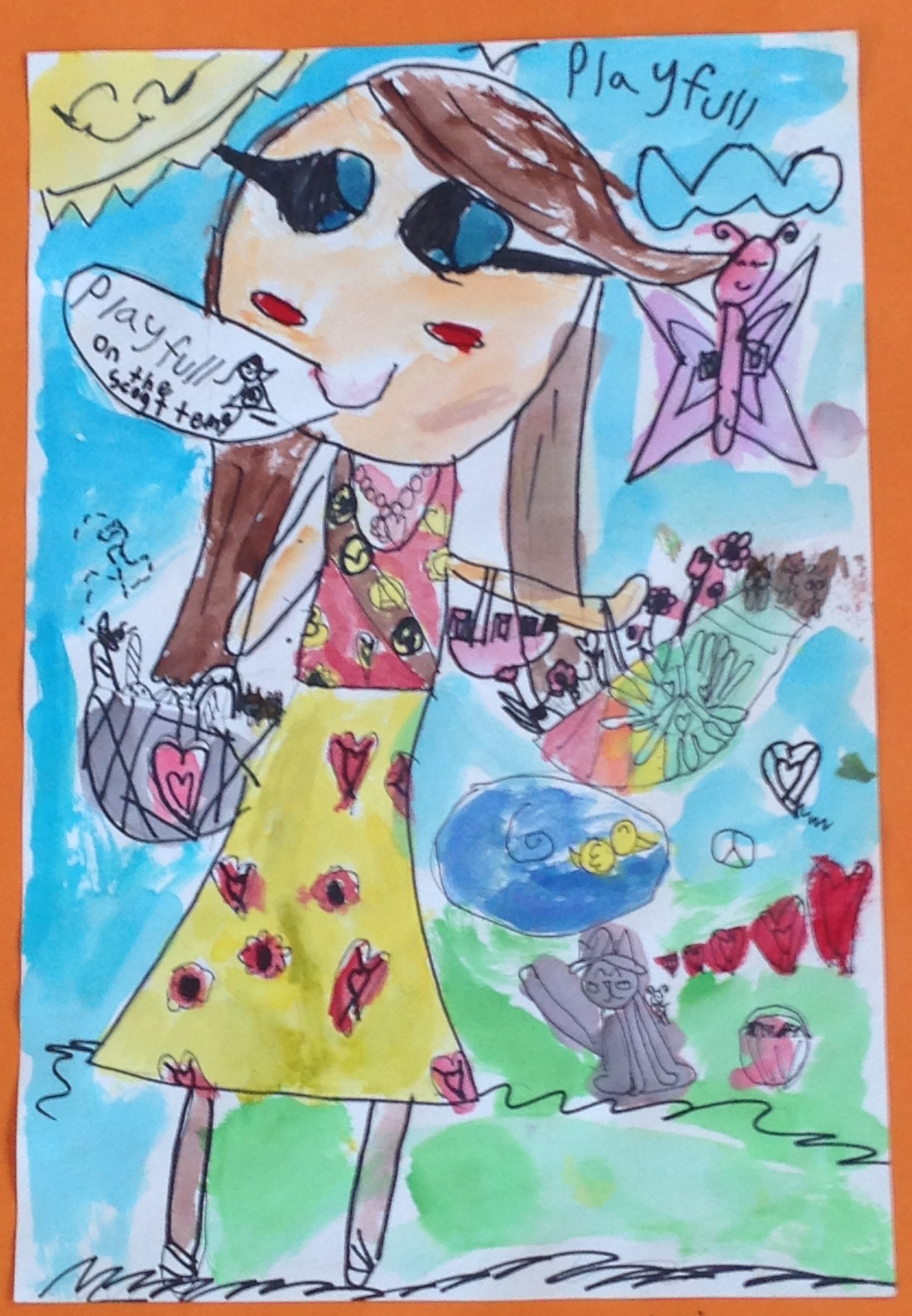
xo
 There’s no one better than our dogs to remind us of the present moment. They can offer ground when you can’t find it yourself. They don’t get caught up in drama and provide snuggles when you need them.
This week offered two emotionally charged meetings at work. Coincidentally, different pups were also in attendance. This is not the norm…but it should be.
The first was a therapy puppy in training. This little guy kept to himself on the carpet, chewed his squeaky toy and seemed generally disinterested in our emotional conversation. Every now and again he’d lift his head, look around and sigh to remind us he was there before falling asleep. He practiced as much patience as a puppy can and did quite well. I was comforted by his presence and felt more grounded because he was there.
The subsequent meeting was attended by a teacher’s pet (no pun intended). There was a doggie daycare issue and timing called for his attendance that day. He lay there leashed to his owner and intermittently whined with anticipation that they might have gone outside to play. He was never disruptive…just attentive enough to to let her know he was present and eager to leave whenever she was ready.
For all the times they chew our favorite things, shed all over, eat things they shouldn’t and throw up on the floor there are thousands more when they offer unconditional love, greet us excitedly at the door, warm our feet, offer cuddles, help us get exercise and listen to our hearts with open ears.
This is my thank you note to dogs. You embody living in the moment and you’re some of my greatest teachers.
xo
Looking for good in the world…

Taking this demonstration very seriously before heading off on her first investigation.
This is how the seed for “Kindness Detectives” was planted…
A colleague of mine decided to celebrate his birthday through giving rather than receiving. His birthday falls close to the 100th day of school and as elementary school teachers this day is a big deal. My first grade class got together with our 5th grade buddies and my colleague launched the challenge of doing 100 acts of kindness. As a gift to further motivate our students, he made labels for notebooks and gave each child a mechanical pencil. We also received a poster for our classroom providing ideas for kind things you can do.
We watched a video called Life Vest Inside- Kindness Boomerang. This short, engaging film helped excite the kids about looking around for acts of kindness and encouraged them to think about how they can participate throughout their daily lives.
I have since viewed this TED Talk with Orly Wahba and learned more about the creator of the video. She’s a middle school teacher who shares our vision for creating a society where kids pay attention to and appreciate kindness around them as well as learn how to foster kindness and compassion for themselves.
Following the gathering with our 5th grade buddies, we returned to our classroom and I introduced the idea to become “Kindness Detectives”. I wove yarn through each of their notebooks and as they accepted the investigative challenge, they were each “crowned” with their special book. In my state of enthusiasm, I went so far as to create a chant to get us feeling like true detectives…or kindness superheroes…on the look-out for good happening in the world. The kids immediately set off taking notes about things they see, hear and do.
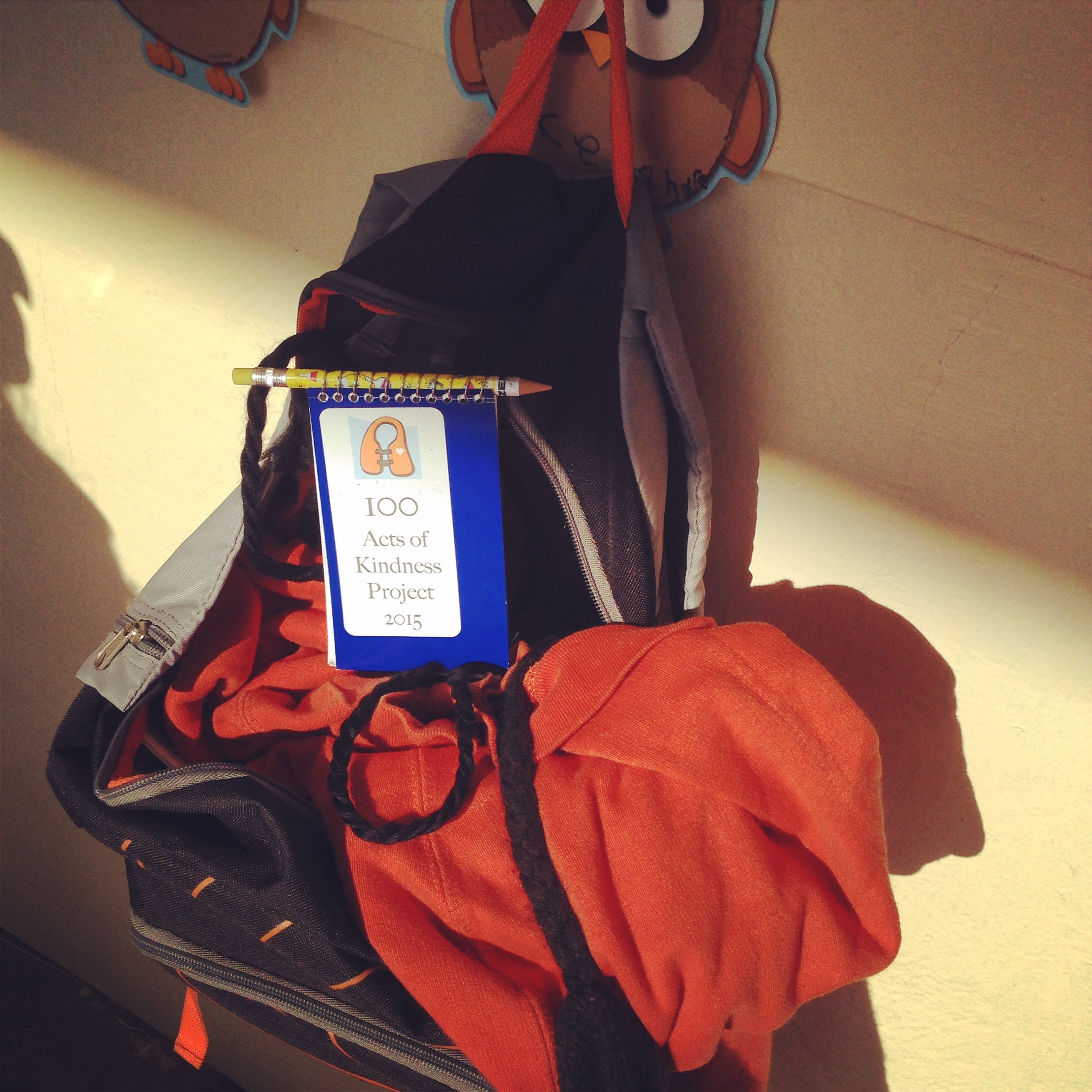
Sometimes Kindness Detectives need to put their notebooks down and go play outside!
Not only was it fun to collaborate across grade levels, but watching the kids feel excited to pay attention to kindness in new ways brought us all more joy. We’ve continued bringing the notebooks back and forth to school and frequently share about our findings. This adventure has not only created a purpose for writing, we’re also growing into more thoughtful human beings.
xo
 Connecting With Heart