
As we continue to grow our mindful awareness at school, I’ve been teaching my first graders how to pay attention to thinking. To introduce the practice, we sit in a circle, settle in to our mindful bodies and take a few deep breaths together. Next, I ring the bell and we try to be still and quiet as we notice any thoughts we’re having. During this time, I suggest they may have many thoughts or notice just a few. Perhaps they have a repeating thought or notice they’re distracted. It’s our time to investigate what happens.
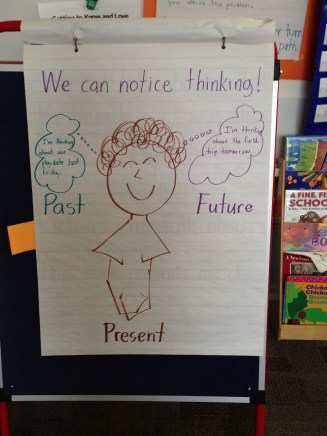 After about two minutes, we listen to the sound of the bell until it goes away completely. Then, each child has the opportunity to share what thoughts they noticed (sharing is optional). Each student listens carefully as we share what’s on our minds. If someone in the group can’t hear, they do a “silent wave” indicating they’d like the speaker to repeat a bit louder. As we build this practice into our daily routine, I guide them toward noticing whether their thoughts are in the future, past or present. Using a visual is helpful with younger children so I draw a person sitting in a mindful body position with thinking bubbles going out toward the future, past and present. In each bubble, I write a thought taken directly from our group sharing. Since we’ve also practiced noticing emotions that visit, many kids mention a thought followed by how they feel when that thought arises.
“I’m thinking about the play date I had on Friday and excitement comes to visit.”
“I keep thinking about my violin recital that’s going to happen soon. I feel scared and nervous. I also feel worried because I need to practice a lot.”
“I notice that my body feels tired and I’m sleepy.”
“Anger and frustration came to visit when I couldn’t finish my breakfast this morning.”
Paying attention to our thoughts is one of many practices allowing children important time and space to investigate their inner world at school. Not only does this practice foster concentration, communication and connection within our classroom community, it provides me the opportunity to listen to the hearts and minds of my students. From here, I get to know them more fully and am better able to provide authentic and meaningful support.
xo
 Connecting With Heart